Forthcoming events
The next meting for the History Group will be on Wednesday 16th September, at 2.00pm. It will be in Caldicot Methodist Church.
The speaker will be Graham Duke.
The subject will be Hitlers Favour Spy.
The History Group had a Guided walk around Caldicot Castle 15th July 2025
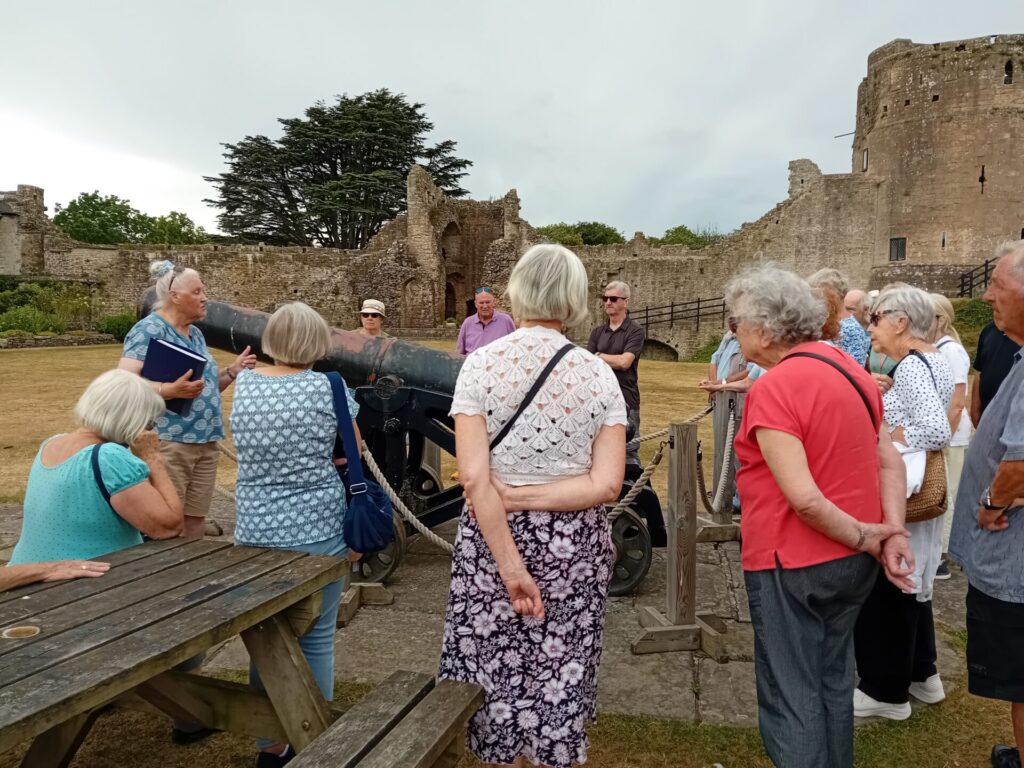


The u3a History Group enjoyed a guided tour of Caldicot Castle given by Pauline Heywood on the afternoon 15th of July. We were a large group of 25 people plus, all eager to find out more, and what a treat we had. As one member said: the best afternoon she’d had in a long time.
The castle was built on the site of strategic value near the Bristol Channel allowing observation of the comings and goings of ship traffic and eased transport of supplies to the site. The Normans like the Romans before them, recognised its importance.
Around 1221 after Humphrey de Bohun inherited the lordship, a round stone keep was constructed. The de Bohuns kept control of the castle as hereditary constables until 1373, when it became the property of the Crown. The keep is so interesting, made more so by Pauline’s talk. It has nine-foot-thick walls made of local gritstone and the four storied keep was a formidable structure which would have withstood virtually any assault. The next phase of construction at the Castle was the sturdy curtain walls interconnected by round corner towers. The towers at the southeast and southwest angles were powerful, albeit somewhat shorter and smaller than the keep, and also protected with battlements and timber hoarding. Midway between the great keep and the southwest tower, the castle’s first gatehouse was erected in the mid-13th century. This was a simple gateway which pierced the wall of yet another round tower and still stands to almost its full height and would have allowed rapid and covert movement into and away from the castle.
In the 1340s the Great Hall was constructed along the interior wall adjacent to the southeast tower, probably a timber building, and all that remains are some decorative windows. In 1373 the last male de Bohun died and the castle passed to two daughters, Eleanor and Mary. Mary de Bohun married Edward the III’s grandson, the future Henry IV, and Eleanor wed Thomas de Woodstock, son of King Edward lll and Duke of Gloucester. In the late 1380’s Woodstock began an extensive and costly building programme. On the north side, Thomas built the three-storied Woodstock Tower and Postern Gate, carving his name and his wife’s (“Alianora”) into the masonry.
Unfortunately for Thomas Woodstock, his enjoyment of Caldicot Castle was to be brief. In 1397 he was smothered in Calais, and the castle was inherited by Thomas’s daughter, Anne. Nevertheless, his greatest achievement was the great gatehouse with elaborate defences and access across a drawbridge, two portcullises, two heavy gates and three murder holes. On the upper floor was a grand apartment range, flanked by twin latrine towers, implying that the residential focal point of the castle had shifted from the keep to the main gatehouse - a trend of the Middle Ages. Caldicot was right at the heart of the politics throughout this period.
Little happened after this through the many generations until the antiquary, Mr J. R. Cobb bought Caldicot Castle in 1855, and set out to restore it to its earlier splendour. He was responsible for the rescue of at least two other Welsh castles, Manorbier and Pembroke, in West Wales. Cobb made Caldicot Castle his home for a time and devoted much energy to rejuvenating the structure. Eventually it became the responsibility of Monmouthshire C. C. After the second world war it was used to even house local families. What we see today is an appropriate mix of the old and the restored, for most of the original stone work and design was left intact.
Thank you Pauline for a lovely afternoon.
Joy
Thank you Joy, for writing such a comprehensive article about the guided tour.